

Is the Impedance of a 460 MVA Transformer Higher Than a 240 MVA Transformer?
When comparing transformer impedance, it is important to distinguish between percentage impedance (%Z) and actual impedance measured in ohms (Ω). The two are related but tell very different stories, and confusing them can lead to significant errors when assessing fault levels and network strength.
Percentage Impedance vs Actual Impedance
At first glance, a larger transformer such as a 460 MVA unit may appear to have a higher impedance, because manufacturers often specify a higher percentage impedance than for a smaller unit. For example:
- A 240 MVA transformer may have a percentage impedance of around 15 – 18%.
- A 460 MVA transformer may have a percentage impedance of around 18 – 22%.
However, percentage impedance alone does not tell the full story. The actual impedance of a transformer in ohms depends on both its percentage impedance and its power rating. As transformer rating increases, the impedance in ohms typically decreases, even when the percentage impedance increases.
Key point: A 460 MVA transformer will usually have a lower actual impedance in ohms than a 240 MVA transformer operating at the same voltage level, despite having a higher percentage impedance.
Actual Impedance and Fault Levels
Lower impedance allows more current to flow during a fault condition. This means:
- A 460 MVA transformer contributes higher fault current.
- A 240 MVA transformer contributes lower fault current.
- Systems supplied by larger transformers generally have higher fault levels and require equipment with higher short-circuit ratings.
This is a counterintuitive but important result. Engineers who rely solely on percentage impedance when comparing transformers may incorrectly conclude that the larger unit is more restrictive to fault current, when in reality it is the stronger source.
Why Larger Transformers Increase Fault Levels
Transformer size is directly related to the amount of power it can transfer. Although larger transformers are often designed with slightly higher percentage impedance to help limit fault currents, the increase in transformer rating is typically much greater than the increase in percentage impedance.
As a result, the larger transformer presents a lower overall impedance to the network, and therefore allows a greater short-circuit current to flow.
Practical Example
Consider two transformers connected to the same 132 kV network:
| Transformer | Rating | % Impedance | Actual Impedance (Ω) | Fault Current Contribution |
|---|---|---|---|---|
| Transformer A | 240 MVA | 18% | Higher | Lower |
| Transformer B | 460 MVA | 20% | Lower | Higher |
Despite having the higher percentage impedance, Transformer B (460 MVA) will have the lower impedance in ohms and will therefore contribute a significantly higher fault level to the network.
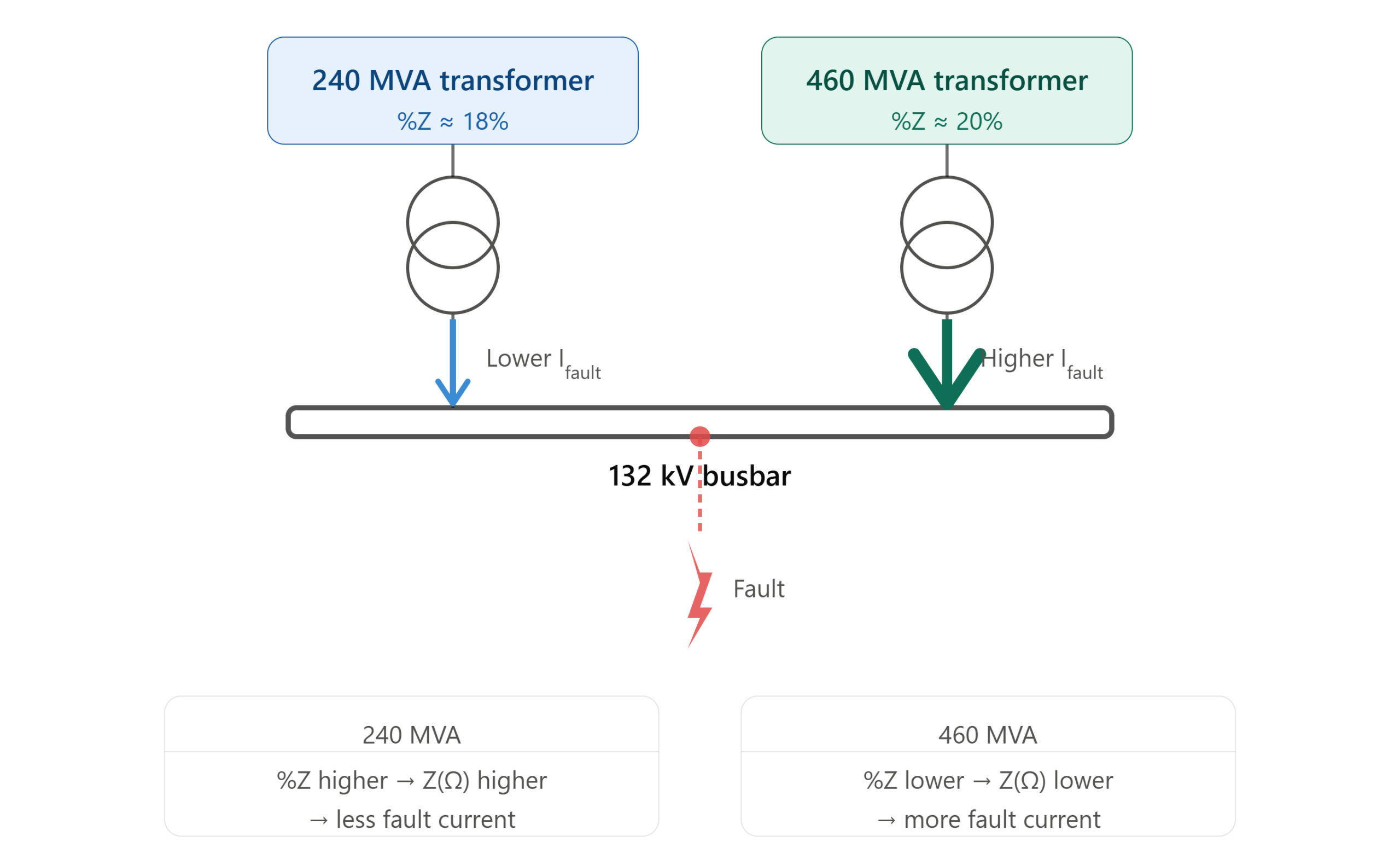
Figure 1: As transformer rating increases, the actual impedance in ohms falls even though percentage impedance rises — resulting in higher fault current contribution from larger transformers.
What This Means for Fault Level Assessments
When assessing network strength and fault levels, engineers should not compare transformers based solely on percentage impedance. A 460 MVA transformer is typically a stronger source than a 240 MVA transformer, resulting in:
- Lower impedance in ohms.
- Higher prospective fault current.
- Increased network fault levels.
- Greater short-circuit duty on switchgear and other connected equipment.
Key Takeaway
Fault level assessments should always consider transformer rating, voltage level, percentage impedance, and the wider network configuration together — never percentage impedance alone. Relying on %Z in isolation can lead to an incorrect and potentially dangerous underestimate of the fault level a larger transformer introduces to the network.