
Net Zero Impacts on the Electrical Grid
Engineering Challenges and Solutions
1.0 Introduction
Net-zero refers to a state in which the amount of greenhouse gases released into the atmosphere is balanced by the amount removed over a given period. The Earth is already around 1.2°C warmer than pre‑industrial levels with global emissions continuing to rise. Limiting warming to 1.5°C is widely recognised as critical to avoiding the most severe impacts of climate change, and reaching net-zero is the primary means of achieving this. Under the Paris Agreement, this requires global emissions to fall rapidly, by around 45% by 2030, and net zero by 2050. In response, many countries, cities, companies and institutions have committed to net‑zero targets[1].
Reaching net zero is essential because even small increases in global temperature significantly raise risks to human and natural systems. The IPCC highlights that impacts such as extreme heat, flooding, drought, food insecurity, ecosystem degradation and sea level rise intensify sharply beyond 1.5°C. Many of these effects are non‑linear, meaning damage accelerates rather than increases gradually, increasing the risk of crossing irreversible climate tipping points. Achieving net zero limits both the scale and duration of these risks[2].
The UK has a long history of climate commitments, beginning with adoption of the Kyoto Protocol in 1997[3]. Progress towards net-zero is now managed through legally binding five‑year carbon budgets extending to 2050. Six budgets are currently in place, with the sixth requiring a 77% emissions reduction by 2037, and the Climate Change Committee concluding that while net zero remains achievable, urgent action is still required[4].
2.0 Impacts of Net-Zero on the Grid
As a result of net-zero, many synchronous generators have been replaced by asynchronous renewable generation and High Voltage Direct Current (HVDC) systems. These changes create new challenges for operating a stable and reliable network, including:
- Keeping voltage levels stable
- Preventing voltage collapse
- Ensuring good frequency response
- Managing fast rate-of-change-of-frequency (RoCoF)
- Ensuring the system has enough reactive power
To describe how the UK is overcoming the above challenges, it’s vital to explain why these challenges appear:
2.1 RoCoF
When a synchronous generator trips, the remaining synchronous generators automatically increase their injected active power due to the energy stored in their rotating masses by speeding up. This inertial response limits how rapidly system frequency can change following the disturbance. As a result, the RoCoF following the loss of a large generator is a useful indicator of the overall system inertia. Renewable generators do not possess physical rotating mass and therefore lack this inertia. Without inertia, they are unable to inherently limit RoCoF. Consequently, in low‑inertia power systems the frequency falls more rapidly after a disturbance, reducing the available time for corrective control actions to take effect[5].
2.2 Voltage Stability and Collapse
Voltage is mainly controlled by reactive power and if there is not enough, voltage falls, and vice versa. Engineers use power voltage curves to show the relationship. As the power increases the voltage drops relatively steeply, it gets steeper as the power factor lags and decreases. The distance between normal operating conditions and this collapse point is the voltage stability margin. A healthy system has a wide margin, meaning it can tolerate disturbances without losing voltage control. Because of this behaviour, the system can end up operating closer to the voltage collapse point than operators realise. After a fault, voltage recovery depends on how quickly and how coherently reactive power responds. If reactive power support is insufficient, or if devices respond in an uncoordinated way, voltage can fail to recover even though active power is restored.
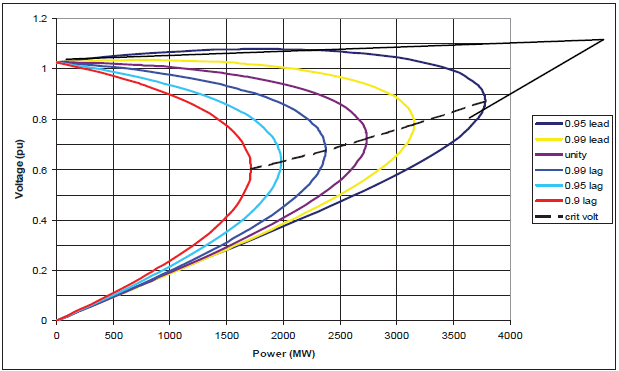
Figure One: Example P-V curve[5]. Without sufficient reactive power, voltage will drop as loading increases or upwards during light loading conditions.
Voltage collapse occurs when the system cannot supply the reactive power demanded by the network, especially after a disturbance such as a fault. When this happens, voltage begins to fall uncontrollably. Strong reactive devices (automatic voltage control, synchronous condensers etc.) keep voltage up until they hit their limits. If those limits are reached during a disturbance and there is no additional reactive support available, voltage can collapse rapidly. Preventing voltage collapse therefore requires both enough reactive power capacity and enough margin so that reactive limits are not simultaneously reached across the system.
2.3 Frequency
Frequency is controlled by the balance between supply and demand, therefore by active power. After a disturbance, generators must increase their active power output, by increasing rotational speed, to stop the decline in frequency. However, their ability to do this depends on voltage being adequately supported. Reactive power supports voltage during and after a fault by limiting how far voltage falls, which helps generators remain synchronised with the system. If voltage is weak, generators may be unable to deliver the required active power even if it is available.
3.0 Solutions
Studies, including work by Ejuh Che[6] show that while variable renewable energy is essential for decarbonisation, its variability and inverter‑based nature challenge traditional power system operation. Conventional grids were designed around predictable, synchronous generation, whereas wind and solar reduce inertia and increase voltage and reactive power issues. The study notes that beyond around 30% renewable penetration[7], these effects become significant and cannot be managed using traditional practices alone, a threshold the UK already exceeds. It concludes that high renewable integration is feasible, but only when supported by adequate measures.
The UK has several ways in which it is responding to the reduction of synchronous generation, these include the following:
3.1 Renewable Generation
For the UK to achieve net zero, renewable generation needs to replace existing fossil fuel sources in order to reduce GHG emissions[8]. Renewable energy sources do not produce greenhouse gases during electricity generation, which directly supports the net‑zero target. While the increasing use of renewables does introduce technical challenges for the power system, it can also help address wider system issues, not only those related to emissions.
One example is the use of grid‑forming inverters, which are a relatively new technology which are not yet mandatory. Traditionally, inverters have relied on a strong existing grid, operating by following the grid’s voltage and frequency characteristics. In contrast, grid‑forming inverters actively create and control voltage and frequency themselves, allowing them to behave in a similar way to synchronous generators[9]. While this capability offers potential benefits for future power systems, grid‑forming inverters are not yet a requirement in the UK system today.
Another is the use of battery energy storage systems (BESS), identified as a key solution for fast frequency response and short‑term balancing. Demand response and controllable loads can also provide valuable flexibility if properly co-ordinated[10].
Synchronous condensers (SC) do not generate active power, but they are often installed specifically to enable higher renewable penetration as they provide real inertia, strong short‑circuit current, and dynamic reactive power. A SC is almost the same as a synchronous generator. The main differences are that the turbine is removed and the shaft is free‑running or fitted with a flywheel, and an electrical input is only needed to keep it spinning.
Finally, geographical diversity of renewable generation also improves stability. Wide‑area deployment of renewables reduces the likelihood of large, sudden power imbalances because fluctuations in one region are often offset elsewhere. This reduces the depth of frequency drops after faults and lowers the probability of cascading voltage collapse.
3.2 HVDC
HVDC plays a role in connecting the UK to neighbouring electrical grids. HVDC interconnectors allow the UK to import or export electricity as required, depending on system conditions. This is particularly beneficial during periods when domestic generation is low due to weather conditions, as the UK can import power directly from mainland Europe to maintain security of supply.
A report by G. Jang[11] argues that HVDC should no longer be treated as a simple “power transfer cable”, but as an active grid asset that can deliver grid services, including frequency and voltage support, angle stability improvement, fault current management and power flow control.
A key voltage stability concern is the sharpening of the P–V curve. Future network studies show that it required very large amounts of reactive power compensation in areas connecting HVDC schemes. This additional compensation steepens the P–V curve, which means the system operates closer to its voltage collapse point and becomes more sensitive to disturbances. However, new VSC-HVDC has reactive power compensation capabilities which means it’s able to inject reactive power into the grid, making it a more preferred choice. This represents a major advantage over older HVDC technologies, which consume reactive power, require additional capacitor banks for voltage support, and cannot independently control active and reactive power[5].
Voltage recovery after faults is an emerging stability issue but VSC-HVDC links can restore active power much faster than nearby synchronous generators following a fault. If not carefully controlled, this mismatch in recovery speed can destabilise generators during post‑fault conditions. To protect voltage stability, the authors note that HVDC active power recovery may need to be deliberately slowed so that synchronous machines can recover without losing synchronism[5].
Most HVDC schemes in the UK use VSC technology, which is important for operating a modern electricity grid. Voltage collapse is often linked to insufficient reactive power during high loading or after faults. HVDC helps reduce this risk because DC cables do not consume reactive power and VSC converters can actively support AC voltage, even at low system voltages. HVDC links also provide fast frequency support, with active power adjusted within about 100ms. This rapid control helps limit frequency drops and RoCoF after faults or generation losses, which is especially valuable in low‑inertia systems where HVDC can also emulate inertia[12][13].
HVDC cables also are used to overcome thermal limits on existing transmission lines by increasing power transfer capacity between regions. Scotland generates large amounts of electricity, which must often be transported south to major demand centres such as London. During periods of high output, overhead lines can reach their thermal limits, forcing wind turbines to shut down and causing financial losses. Subsea HVDC links provide an effective solution by transmitting large volumes of electricity efficiently over long distances with low losses. This avoids the need for new overhead lines and reduces generation curtailment[14].
3.3 FACTS
FACTS are defined as the “use of solid‑state (power electronic) devices to control bulk power flow and improve transmission system performance”[15]. An AC network without FACTS is mostly passive, meaning that power flows are determined mainly by the physical characteristics of the lines. FACTS technologies were introduced to provide faster, more flexible, and more effective control of power system operation[15].
According to Siemens, FACTS are vital to the energy transition because they improve grid stability through fast voltage and reactive power control. They also increase transmission capacity without new lines and support the integration of variable renewable generation by adapting quickly to changing power flows[16].
FACTS play an important role in integrating large volumes of renewable energy by improving voltage stability and managing reactive power. Many wind and solar generators are connected to the grid through power‑electronic converters, which means they provide little inherent voltage support compared with traditional synchronous machines. FACTS devices can respond very quickly to system changes by injecting or absorbing reactive power as required. This rapid response helps maintain acceptable voltage levels during sudden variations in wind speed or solar outputs and allows renewable power plants to remain connected during disturbances[17].
Static Voltage Compensators (SVCs) and STATCOMs are devices used to inject or absorb reactive power which will pull the voltage down or up as required, which is especially important after a fault[17].
FACTS also significantly enhance the utilisation of existing transmission infrastructure, which is critical for net zero power systems. Series FACTS devices increase the power transfer capability of transmission lines by actively optimising reactive power and reduce I²R losses across the network. Lower losses mean less generation is required to meet demand[17].
FACTS devices reduce or remove system constraints by controlling power flows and voltages on the network. When the constraints are eased, operators have more freedom to choose which generators run and can prioritise renewable generators, which have very low running costs[17].
3.4 Automation
There is a general consensus that the network will require more automation as the network gets more advanced. With the integration of renewable energy and electronics, the network is becoming more complex, with tighter operational margins[18].
Automation is becoming essential to ensure that an increasingly complex power network operates safely and efficiently. Automated systems support grid operation and control by enabling monitoring and direct control of assets through advanced sensing. Examples include dynamic line ratings and advanced power flow management, all of which depend on real-time data, automated switching and algorithm-based decision-making. These tools help unlock additional network capacity and maintain system security without the need to build new circuits[19].
Automation also plays a key role in maintaining system flexibility and real-time balancing. A report from the International Energy Agency[19] highlights that power systems are becoming more dependent on automatic balancing mechanisms to respond quickly to real-time data and prevent rapid changes in system conditions from escalating. The report identifies fast, software-based responses as a cornerstone of future power system operation, particularly during periods of low demand or high renewable generation[19].
The network itself is also becoming increasingly instrumented with sensors to detect faults, constraints, and operating patterns. While this growth in sensing provides valuable insight, it also results in vast amounts of data that are difficult for organisations to manage manually. Advanced sensors, combined with real-time forecasting and automated constraint management, allow this data to be used effectively, ensuring the network is operated as efficiently as possible under current conditions[19].
Automation also plays a critical role in improving network resilience and post‑fault recovery. Automated protection, control, and reconfiguration systems enable faults to be detected, isolated, and cleared far more rapidly than manual intervention, reducing the duration and impact of outages. By allowing the network to respond almost instantaneously to disturbances, automation helps prevent local faults from escalating into widespread system instability, supporting faster restoration and maintaining continuity of supply.
4.0 Coordinated Operation of HVDC, FACTS, Renewable Generation, and Automation
The push to replace fossil fuels with renewable energy has been driven by the UK’s net‑zero target, which introduces a range of technical and operational challenges across the electricity network. No single technology can address these challenges on its own. Instead, secure and resilient operation depends on the effective integration of multiple technologies, each addressing different aspects of system stability and control. When designed and operated together, these technologies complement one another and enable the network to operate reliably under low‑carbon conditions.
Renewable generation provides the energy required to decarbonise the power system but also reduces system inertia and increases variability, which places greater stress on voltage control, frequency response, and reactive power provision. HVDC technology supports this transition by enabling large‑scale power transfer from areas of high renewable generation to major demand centres, while also providing fast and controllable active‑power response to support system frequency and manage cross‑boundary power flows. At the same time, FACTS devices provide rapid, localised control of voltage and reactive power, helping to stabilise the network and prevent voltage collapse under changing and uncertain power flow conditions created by high renewable penetration.
Automation is the element that ties these technologies together. Automated monitoring, control, and protection systems are required to coordinate HVDC controls, FACTS responses, and renewable output in real time. This coordination ensures that assets respond coherently during faults and disturbances, rather than in isolation, allowing the system to recover quickly and remain within safe operating limits. In this integrated framework, renewables supply low‑carbon energy, HVDC manages bulk transfer and frequency support, FACTS maintain voltage stability, and automation ensures fast, coordinated decision‑making. Together, these technologies form a power system capable of meeting net‑zero objectives while maintaining security of supply.
5.0 Conclusion
Achieving the UK’s net‑zero ambitions requires fundamental changes to how the electricity network is designed and operated. The widespread replacement of fossil‑fuelled synchronous generation with renewable energy introduces challenges relating to voltage stability, frequency control, inertia, and reactive power management. This report has shown that these challenges cannot be addressed by any single technology in isolation. Instead, secure and resilient system operation depends on the coordinated use of renewable generation, HVDC, FACTS, and network automation.
Renewable technologies deliver low‑carbon energy, while HVDC enables controllable bulk power transfer and fast frequency support. FACTS devices provide rapid local voltage and reactive power control, and automation ensures these assets respond coherently and at the required speed. When successfully integrated, these technologies allow the power system to withstand disturbances, recover quickly from faults and operate efficiently. Alongside technical solutions, wider considerations such as ethics, risk management, security, and workforce diversity remain critical to delivering a fair, resilient, and sustainable electricity system.
Word Count: 3280
7.0 References
- United Nations, “Net‑Zero Coalition,” United Nations Climate Change, 2024. [Online]. Available: https://www.un.org/en/climatechange/net-zero-coalition Accessed: 14 April 2026.
- European Commission, Joint Research Centre, AR6 Synthesis Report: Climate Change 2023, Knowledge for Policy, 2023. Accessed: 14 April 2026. [Online]. Available: https://knowledge4policy.ec.europa.eu/publication/ar6-synthesis-report-climate-change-2023_en
- United Nations Climate Change. “What is the Kyoto Protocol?” United Nations Climate Change. Accessed: 25 Oct 2024. [Online]. Available: What is the Kyoto Protocol? | UNFCCC
- N. Burnett, I. Stewart, and T. Hewitt, The UK’s Plans and Progress to Reach Net Zero by 2050, House of Commons Library, Research Briefing CBP‑9888, Mar. 13, 2026. Accessed: 17 April 2026. [Online]. Available: https://commonslibrary.parliament.uk/research-briefings/cbp-9888/
- M. M. Osborne, A. Carter, B. Marshall, and V. Hamidi, “The impact of new technology on network resilience,” in Proc. 10th IET Int. Conf. AC and DC Power Transmission (ACDC 2012), Warwick, U.K., 2012, paper C2-105, pp. 190–196, doi: 10.1049/cp.2012.1955.
- E. Ejuh Che, K. R. Abeng, C. D. Iweh, G. J. Tsekouras, and A. Fopah‑Lele, “The impact of integrating variable renewable energy sources into grid‑connected power systems: Challenges, mitigation strategies, and prospects,” Energies, vol. 18, no. 3, art. no. 689, Feb. 2025, doi: 10.3390/en18030689.
- P. C. Ohiri, M. E. Benson, O. C. Chrysogonus, and A. C. J. Anyalewechi, “Impact of renewable energy integration on grid stability: A case study of Nigeria’s power system,” World Journal of Advanced Engineering Technology and Sciences, vol. 14, no. 2, pp. 199–204, Feb. 2025, doi: 10.30574/wjaets.2025.14.2.0058.
- National Energy System Operator (NESO), “Why are renewables vital to achieving net zero?,” NESO, Accessed: May 1, 2026. [Online]. Available: https://www.neso.energy/energy-101/net-zero-explained/why-are-renewables-vital-achieving-net-zero
- National Energy System Operator (NESO), “What is grid forming?,” NESO, Accessed: May 1, 2026. [Online]. Available: https://www.neso.energy/energy-101/electricity-explained/how-do-we-balance-grid/what-grid-forming
- Ahmed, F., Al Kez, D., McLoone, S., Best, R.J., Cameron, C., & Foley, A. (2023) Dynamic grid stability in low carbon power systems with minimum inertia Renewable Energy, Vol. 210, pp. 486–506. doi: 10.1016/j.renene.2023.03.082
- G. Jang, “Special issue on HVDC for grid services in electric power systems,” Applied Sciences, vol. 9, no. 20, Art. no. 4292, Oct. 2019, doi: 10.3390/app9204292.
- Y. Wang, Y. Zhou, D. Li, D. Shao, K. Cao, and D. Cai, “The influence of VSC‑HVDC reactive power control mode on AC power system stability,” Energies, vol. 13, no. 7, art. no. 1677, Apr. 2020, doi: 10.3390/en13071677.
- J. Huang and R. Preece, “HVDC‑based fast frequency support for low inertia power systems,” in Proceedings of the 13th IET International Conference on AC and DC Power Transmission (ACDC 2017), Manchester, U.K., Feb. 2017, pp. 1–6, doi: 10.1049/cp.2017.0040.
- K. Bell and C. MacIver, “Transmission network unavailability – the quiet driving force behind rising curtailment costs in Great Britain,” UK Energy Research Centre (UKERC), Jun. 16, 2025. Accessed: 19 April 2026. [Online]. Available: https://ukerc.ac.uk/news/transmission-network-unavailability-the-quiet-driving-force-behind-rising-curtailment-costs-in-great-britain/
- P. Asare, T. Diez, A. Galli, E. O’Neill‑Carillo, J. Robertson, and R. Zhao, “An overview of flexible AC transmission systems,” Dept. of Electrical and Computer Engineering, Purdue Univ., West Lafayette, IN, USA, Tech. Rep. TR‑EE 94‑36, Dec. 1994.
- Siemens Energy, “Flexible AC transmission systems (FACTS),” Siemens Energy, Accessed: 03 May 2026. [Online]. Available: https://www.siemens-energy.com/global/en/home/products-services/product-offerings/flexible-ac-transmission-systems.html
- M. Tarafdar Hagh, M. A. Jabbary Borhany, K. Taghizad‑Tavana, and M. Zare Oskouei, “A comprehensive review of flexible alternating current transmission system (FACTS): Topologies, applications, optimal placement, and innovative models,” Heliyon, vol. 11, no. 1, Art. no. e41001, Jan. 2025, doi: 10.1016/j.heliyon.2024.e41001.
- U. Pandey, A. Pathak, A. Kumar, and S. Mondal, “Applications of artificial intelligence in power system operation, control and planning: A review,” Clean Energy, vol. 7, no. 6, pp. 1199–1218, Dec. 2023, doi: 10.1093/ce/zkad061.
- International Energy Agency, Electricity 2026: Analysis and Forecast to 2030. Paris, France: IEA, 2026. Accessed 04 May 2026. [Online]. Available: https://www.iea.org/reports/electricity-2026