

Technical Report: Uptake of Low Carbon Technologies on the Grid
Impact Analysis of Electric Vehicles and Heat Pumps
1.0 Introduction
The Earth’s temperature is increasing due to the increase in greenhouse gases (GHG), mainly originating from human activities[1]. The United Kingdom (UK) is committed to reducing its impact on the environment and has taken numerous legislative and strategic actions. The UK adopted the Kyoto Protocol in 1997, which officially entered into force in 2005 to commit participating countries to reduce dynamic GHG emissions[2]. Following this, the Climate Change Act came into force in 2008, binding the government to reduce GHG emissions to at least 80% lower than 1990 baselines. In 2019, an amendment to this legislation updated the target to a mandatory 100% reduction, legally binding the nation to Net Zero by 2050[3][4].
One of the primary climate change policy documents guiding this transition is the Net Zero Strategy (Build Back Greener). Updated in April 2022, it sets out concrete policies and proposals for decarbonising foundational economic sectors based around a structural ten-point plan originally published in November 2020[5].
As part of these sector policies, the government aims to phase out the installation of conventional gas boilers from 2035. One of the primary technology pathways being pushed as a replacement is the use of heat pumps (HPs). While widely deployed globally, HPs currently face a lack of mature domestic supply chains within the UK, meaning manufacturing and installation costs must be driven down. To bridge this gap, the government has introduced a Boiler Upgrade Scheme providing direct financial grants to support consumers making the switch[6].
Another critical area requiring direct intervention is domestic transport, which accounts for a significant proportion of total UK GHG emissions. Within this sector, passenger cars contribute a dominant 55% of total transport emissions and have historically increased year-on-year[7]. The Department for Transport states that transition to a completely zero-emission road fleet will remove 91% of today’s domestic transport GHG emissions. Consequently, billions of pounds have been committed to eliminate structural barriers to Electric Vehicle (EV) ownership and maintain consumer purchasing incentives[7].
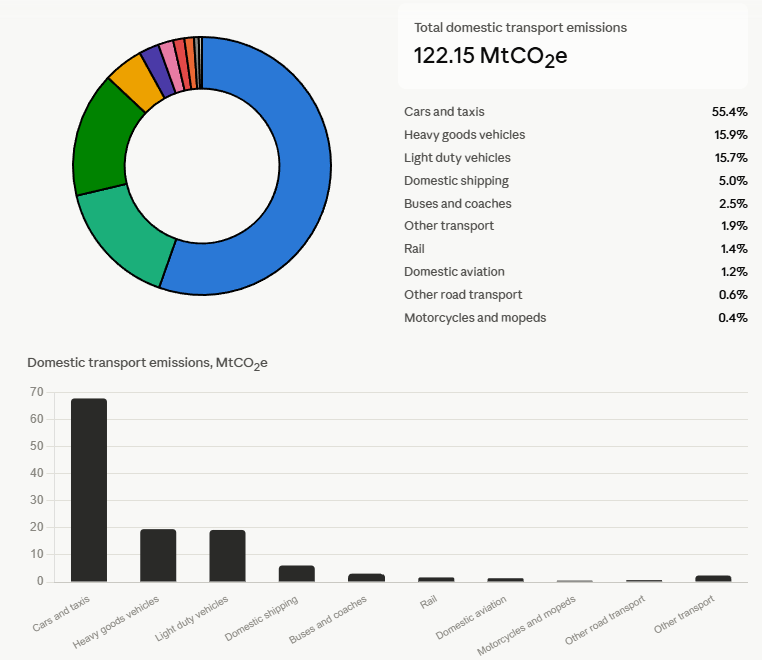
Figure One: Domestic Transport Emissions 2019 highlighting passenger car contributions[7].
While accelerating the rollout of EVs and HPs directly supports the net-zero mandate, it simultaneously creates acute network engineering challenges. Primarily, residential properties will demand significantly more electrical energy, profoundly altering traditional load profiles and exceeding the design capacity of local electrical infrastructure. It is worth noting that while the UK is supporting alternate low-carbon technologies (LCTs) such as hydrogen, these are not currently available at a mass-market scale[23]. This report explores these shifting load dynamics, examines the subsequent impacts on asset infrastructure, and evaluates technical solutions to integrate LCTs cost-effectively.
2.0 Historical Demand
Traditionally, demand on the network has depended on highly predictable macro-factors, including time of day, seasonal sunlight hours, weekday vs. weekend patterns, and major televised events[8]. According to data from the Digest of UK Energy Statistics (DUKES), there is a clear historical trend showing that overall electricity consumption has been steadily decreasing year-on-year due to energy efficiency gains across industrial and domestic appliances[9].
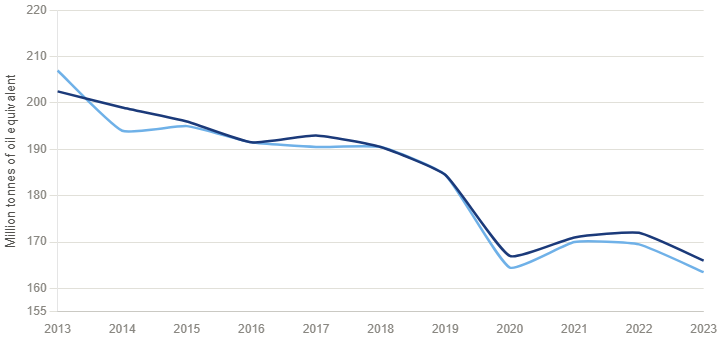
Figure Two: Energy consumption downward trend tracking from 2013 to 2023[9].
Conventionally, the maximum network demand occurred predictably within early winter evenings as residential consumers returned home from work. However, when planning and reinforcing power systems, it is no longer sufficient to evaluate past peak magnitudes alone; asset planners must assess the specific types of load profiles and their temporal duration. As new low-carbon technologies interface with the grid, they diverge sharply from historical load diversities, making it more difficult to anticipate coincidental peak demands. Critically, these devices are connected to Low Voltage (LV) networks that were originally engineered for highly diversified, predictable loads. These changing load shapes necessitate granular assessments of local load profiles and targeted asset upgrades[8].
3.0 Heat Pumps (HP)
The mass adoption of HPs will significantly scale up electricity consumption, particularly during winter months when space heating requirements peak. Consequently, the instantaneous electrical demand from HPs scales directly with weather volatility, introducing new seasonal variance into grid operations[8]. National Grid estimates that approximately 40% of total UK greenhouse gas emissions originate from buildings, driven predominantly by fossil-fuelled space heating[10].
HPs leverage thermodynamic principles identical to vapor-compression refrigeration systems, utilizing a reversing valve to provide a net heating delivery to the property interior. By extracting ambient thermal energy from the external environment, they operate with exceptional efficiency, frequently yielding a Coefficient of Performance (COP) that delivers two to three times more useful thermal energy output than the electrical power input consumed[10].
When evaluated across the entire energy supply chain, HPs require significantly less source energy (between 17 to 25 units depending on operational efficiency) compared to typical gas-fired heaters, which consume up to 105 units of energy to deliver an equivalent thermal output. This translates into a net saving of up to 83 units of primary energy, even when factoring in upstream power generation and transmission losses[11]. Real-world modeling shows that widespread global deployment of HPs could mitigate CO₂ emissions by 1.25 billion tonnes by 2050[11]. Furthermore, as technology matures, thermodynamic efficiency is projected to rise from current limits of 30%–50% up to 40%–60% by 2050, solidifying their performance advantages over natural gas alternatives[11].
An analysis by Z. Wang[12] using residential smart meter data underscores the critical role of demand diversity. *After-Diversity Maximum Demand* (ADMD) represents the diversified peak energy demand per property measured across a large statistical group, accounting for the reality that individual households do not experience maximum load concurrently. The study demonstrates that winter gas peak demands have historically trended nearly 7 times higher than electricity peaks. After accounting for diversity effects, individual peak demands are reduced by 33% for gas systems and 47% for electrical systems, illustrating how load diversity prevents system over-sizing and lowers infrastructure integration costs while ensuring security of supply[12].
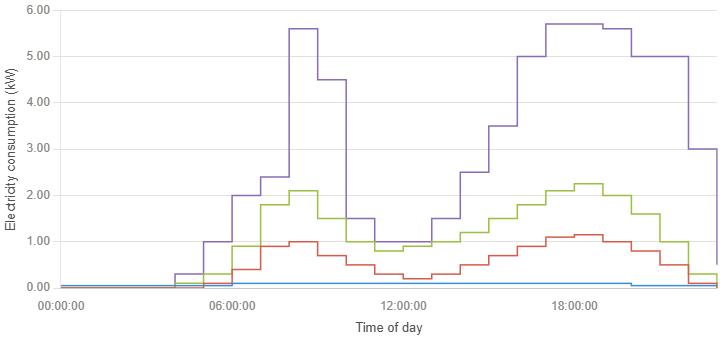
Figure Three: Electricity backed HPs demand profile (~5.75kW)[8].
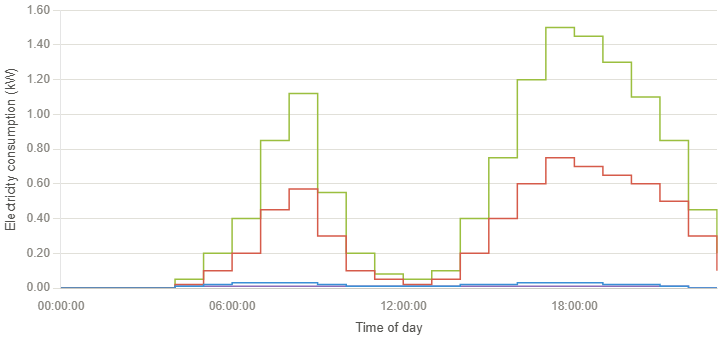
Figure Four: Gas backed hybrid HPs demand profile (~1.50kW)[8].
Figures Three and Four contrast the stark difference in network impact between configuration types: gas-backed hybrid systems present a significantly lower electrical peak draw (~1.50 kW) compared to pure electricity-backed configurations (~5.75 kW). Consequently, the ultimate choice of technology mix will heavily dictate the volume of network reinforcement required. To guarantee absolute decarbonisation, the UK strategic direction points toward pure electricity-backed configurations, fundamentally escalating coincident demand. Crucially, HPs exhibit very low operational diversity because their duty cycles synchronize during widespread low-temperature weather events, concentrating load stresses on the grid[8].
4.0 Electric Vehicles (EV)
Legislative mandates dictate that 80% of new passenger cars sold in the UK must be zero-emission by 2030, rising to 100% by 2035, supported by a target of 300,000 public charging points by 2030[13]. While EV adoption curves have risen, the removal of direct consumer purchasing subsidies since 2022 means entry-level asset costs remain high (£27,000 – £30,000)[14]. Nonetheless, the compounding volume of EVs will inevitably place significant stress on distribution networks. The core objective of EV integration is to ensure that the active power utilized for charging is supplied by zero-carbon generation sources, eliminating tailpipe transport emissions.
The compounding load impact of unmanaged EV charging is substantial. Simulated models executed on a representative medium-density urban network encompassing 1,264 residential properties utilizing localized empirical charging distributions show an immediate demand surge, with peak network loading increasing by approximately 500 kW under coincidental charging scenarios[15].
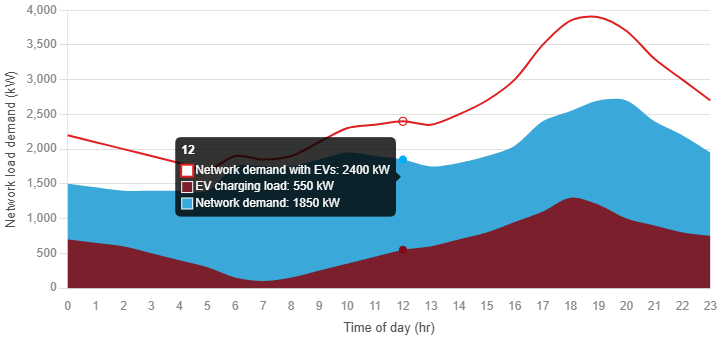
Figure Five: Simulated load demand profile for a medium density urban network (1,264 properties)[15].
Empirical load profiles reveal that under unrestricted charging conditions, maximum demand is heavily concentrated between 18:00 and 06:00, coinciding with evening home-arrival times. However, exact charging curves vary across regions based on several variables, including the density of non-domestic fleet profiles, vehicle battery capacities, geographic location, and single- versus three-phase service connections[8].
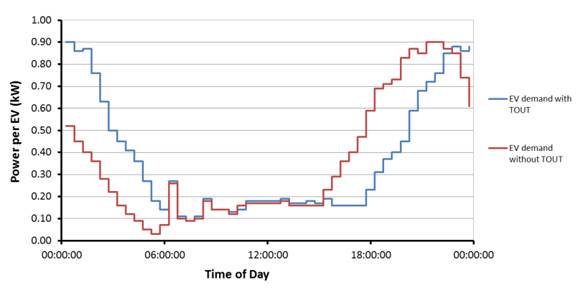
Figure Six: Demand profiles and charging windows of EVs across standard time boundaries[8].
While domestic EV chargers typically operate on single-phase connections, their long, continuous duty cycles distinguish them from traditional household appliances, creating structural power imbalances across distribution networks. This unbalanced charging can induce harmonic currents, leading to corresponding harmonic voltage distortion[16]. This introduces technical challenges for Distribution Network Operators (DNOs) obligated to maintain system voltage variations within the statutory limits set by the Electricity Safety, Quality and Continuity Regulations (ESQCR) (+10% and -6%)[17]. Phase unbalance reduces network operating efficiency, induces neutral current flow, and can cause asset overheating or premature failure of transformer components.
5.0 Combined Impacts
The cumulative impact of concurrent LCT adoption has been modeled extensively, notably within Dutch low-voltage distribution network simulation studies[18]. Empirical analysis indicates that HPs introduce high grid volatility due to their highly frequent cycling patterns. During winter test periods, concurrent HP operations caused severe local distribution transformer and feeder line overloading alongside steep voltage drops. Because HPs cycle on/off abruptly to maintain internal building temperature setpoints, they tend to cause short-duration, high-magnitude voltage violations. Conversely, EVs introduce prolonged load stressors due to extended continuous charging windows, though the instantaneous step-change magnitude is lower.
The operational worst-case scenario occurs during winter evening peaks, when space heating and vehicle charging synchronize. In heavy suburban network simulations, coincidental load spikes forced transformer loading to exceed 800% of nominal rated capacity, driving network voltage drops down to an extreme low of 0.42 p.u.[18]. Although derived from Dutch network configurations, these simulation outcomes map directly to the technical risks facing UK infrastructure:
- Transformer Overloading: Total demand exceeds rated capacity, leading to thermal stress, accelerated insulation degradation, and catastrophic asset failure.
- Line Overloading: Excessive current densities across overhead lines and underground cables trigger high thermal expansion, increased line resistance, and compounding system efficiency losses.
- Voltage Deviations: Severe localized drops violating statutory quality limits, causing voltage imbalance and magnitude variations that endanger consumer equipment[19].
6.0 Options for Network Operators
To counter these challenges, network operators must manage a high degree of uncertainty regarding localized connection rates. Advanced forecasting and predictive modeling are critical tools to identify infrastructure bottlenecks before they cause outages. Operators must balance this forecasting to execute required reinforcements without risk of asset over-investment[8]. DNOs are legally bound under Section 3 of the Electricity Act 1989 to optimize network developments in a strictly cost-effective manner for consumers[20].
Conventional physical reinforcement focuses on up-rating substation transformer capacities and deploying larger cross-sectional underground cables to handle the increased thermal loads. These physical assets can be combined with localized utility-scale battery energy storage systems (BESS) and distributed generation to buffer peak demands[23].
Feasibility studies by James Wilson highlight alternate engineering models, such as deploying standalone, off-grid EV charging hubs powered by dedicated renewable generation. This configuration can generate significant excess energy that can be exported back to the primary grid, though the current literature lacks comprehensive integration tracking for concurrent HP loads or detailed lifetime cost-benefit analyses for consumers[21]. Alternatively, transitioning conventional residential properties from single-phase to dedicated three-phase service connections can mitigate phase unbalance, reducing distribution losses by up to 30% and lowering structural grid stress[22]. However, a lack of clear research on consumer pricing structures makes it difficult to assess which solutions offer the best combination of technical and cost efficiency.
7.0 Conclusion
The UK’s legal commitment to Net Zero has driven rapid policy shifts toward low-carbon technologies like EVs and HPs. While these technologies deliver essential environmental benefits, their mass integration creates significant technical challenges for electrical distribution networks. Coincidental peak loading can cause voltage violations, line and transformer overloading, and reduced operating efficiency.
Addressing these risks requires a combination of accurate demand forecasting, targeted asset reinforcement, and innovative options like three-phase conversions, smart charging networks, and demand-side management. Moving forward, network operators must adopt balanced, proactive planning models to safeguard grid stability while ensuring cost-effectiveness for the consumer.
8.0 References
- M. Maslin, *Global Warming: A Very Short Introduction*, Oxford University Press, 2004.
- United Nations Climate Change, “What is the Kyoto Protocol?”, United Nations Climate Change. Accessed: 27 November 2024.
- Parliament of the United Kingdom, *Climate Change Act 2008*, Chapter 27, 2008.
- Parliament of the United Kingdom, *The Climate Change Act 2008 (2050 Target Amendment) Order 2019*, No. 1056.
- UK House of Commons, *The UK’s plans and progress to reach net zero by 2050*, Research Briefing, N. Burnett, S. Hinson, I. Stewart.
- UK Secretary of State for Business, Energy and Industrial Strategy, *Heat and Buildings Strategy*, London.
- UK Department for Transport, *Decarbonising Transport: A Better, Greener Britain*, London.
- National Grid, “Distribution System Operability Framework (DSOF)”, National Grid. Accessed: 30 November 2024.
- K. Harris, “Digest of UK Energy Statistics (DUKES) Annual data for UK”, Department for Energy Security & Net Zero, London, July 2024.
- National Grid, “How do heat pumps work?”, National Grid Group. Accessed: 19 November 2024.
- International Renewable Energy Agency (IRENA), *Heat Pumps: Technology Brief*, IRENA, 2013.
- Z. Wang et al., “Sizing of district heating systems based on smart meter data: Quantifying the aggregated domestic energy demand and demand diversity in the UK,” *Energy*, vol. 193, Feb. 2020.
- Department for Transport & Office for Zero Emission Vehicles, “Pathway for zero emission vehicle transition by 2035 becomes law,” Gov.uk.
- International Energy Agency (IEA), “Trends in electric cars – Global EV Outlook 2024,” IEA. Accessed: 29 November 2024.
- I. Nutkani et al., “Impact of EV charging on electrical distribution network and mitigating solutions – A review,” *IET Smart Grid*, Feb. 2024.
- J. Hernández, “Unbalance characteristics of fundamental and harmonic currents of three-phase electric vehicle battery chargers,” *IET Generation, Transmission & Distribution*, Oct. 2020.
- Secretary of State, *The Electricity Safety, Quality and Continuity Regulations (ESQCR) 2002*, UK Statutory Instruments.
- N. Damianakis, “Assessing the grid impact of Electric Vehicles, Heat Pumps & PV generation in Dutch LV distribution grids,” *Applied Energy*, vol. 352, 2023.
- L. Yun, “Voltage Balancing on Three Phase Low Voltage Feeder,” University Technical Dataset Report. Accessed: 03 December 2024.
- Secretary of State, *Electricity Act 1989*, UK Legislation.
- J. O. N. Wilson and T. T. Lie, “Off-grid EV charging stations to reduce the impact of charging demand on the electricity grid,” *IEEE Workshop on the Electronic Grid (eGRID)*, Auckland, New Zealand, 2022.
- A. Urquhart, “Electric vehicle charging with three-phase domestic connections,” *CIRED Workshop on E-mobility and Power Distribution Systems*, Paper No. 1455, June 2022.
- UK Department for Business, Energy & Industrial Strategy, *Electricity Networks Strategic Framework: Appendix 1 – Electricity Networks Modelling*, London, Aug. 2022.