Induction motors experience several categories of losses, each representing energy that does not contribute to useful mechanical output. These losses collectively reduce the motor’s efficiency and are an important part of performance analysis.
- Stator Copper Losses (I²R Losses)
These occur in the stator windings due to the resistance of the copper conductors. As current flows through the stator coils, electrical energy is dissipated as heat. The magnitude of these losses depends on the current drawn by the motor and the resistance of the stator windings.
- Rotor Copper Losses (I²R Losses)
Similar to the stator, the rotor conductors also have resistance. Because the rotor current is induced rather than supplied directly, these losses are proportional to the slip of the motor. A portion of the power transferred across the air gap becomes rotor copper loss before the remainder is converted to mechanical power.
- Core (Iron) Losses
The stator core is made of laminated steel, which experiences two types of magnetic losses:
- Hysteresis Losses: Caused by the continuous reversal of magnetisation in the iron core as the magnetic field rotates.
- Eddy Current Losses: Circulating currents induced within the iron laminations, which generate heat. Core losses depend mainly on voltage and frequency and are present even when the motor is unloaded.
- Mechanical Losses
These losses arise from moving parts within the motor and include:
- Friction Losses: Generated at bearings and other contact surfaces as components rotate.
- Windage Losses: Caused by the rotor and fan pushing air around inside the motor housing. The air movement not only creates resistance (and therefore losses) but also serves a useful purpose by helping cool the motor.
The diagram below, illustrates the power flow through an induction motor, showing how the input electrical power 𝑃𝑖𝑛is progressively reduced by different losses as it moves through the machine. After entering the stator, the power crosses the air gap as air-gap power (𝑃𝐴𝐺), which represents the total power transferred to the rotor’s magnetic field. From this, the portion that remains after rotor copper losses becomes the converted mechanical power (𝑃𝑐𝑜𝑛𝑣), corresponding to the mechanical power developed at the shaft before mechanical losses. After subtracting friction, windage, and other miscellaneous losses, the remaining
power is the useful output power (𝑃𝑜𝑢𝑡) delivered to the load. The diagram visually emphasises how each loss reduces the available power as it progresses from electrical input to mechanical output.
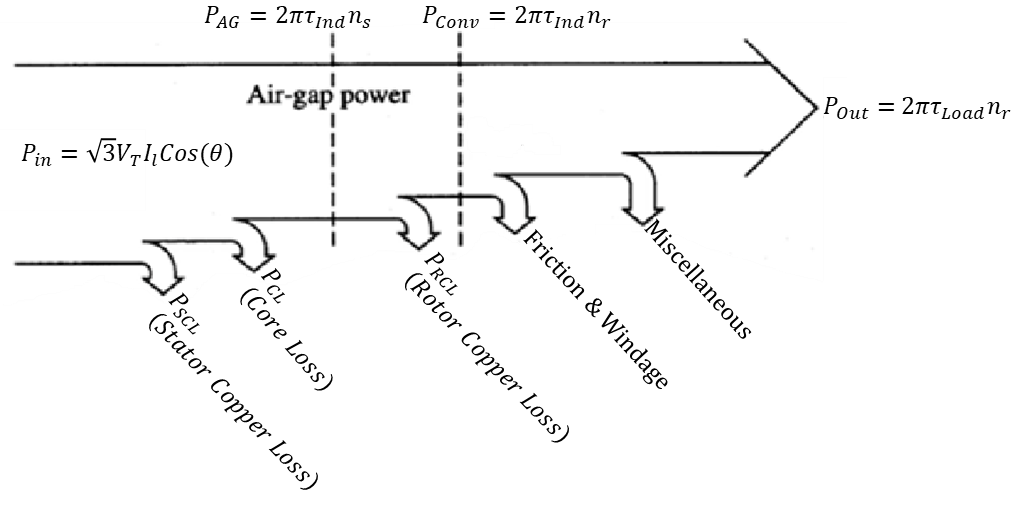
Note: nr for the above equations must be revolutions per second.
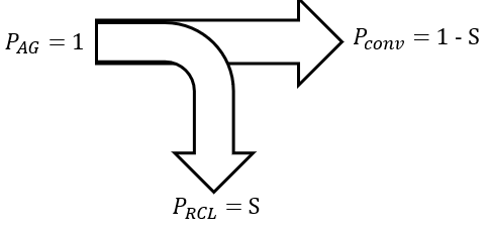
The diagram below shows how the air‑gap power () delivered to the rotor is divided into two parts.
- A portion equal to S (the slip) flows downward and represents the rotor copper loss (
 ). This loss occurs because the induced rotor currents produce heat due to rotor resistance. Which makes sense, as the only loss between the air gap and the mechanical power will be the heat loss.
 - The remaining portion, equal to
 , continues to the right as the converted mechanical power (
 ). This is the power actually available to produce torque before mechanical losses.
Because slip determines how much of the air‑gap power is lost as heat in the rotor, the diagram visually shows the fundamental relationship of the following equations:
What is Slip?
Slip is the difference between the synchronous speed of the rotating magnetic field and the actual speed of the induction motor rotor. It is an essential characteristic of induction motors because the rotor must rotate slightly slower than the magnetic field to induce current and produce torque. Slip is usually expressed as a percentage of the synchronous speed.
The amount of slip varies with the motor load. At no load, slip is very small, while under heavier loads it increases as the motor requires more torque. Understanding slip is important for analysing motor performance, efficiency, speed regulation, and torque characteristics in industrial and commercial applications.
Example Question One
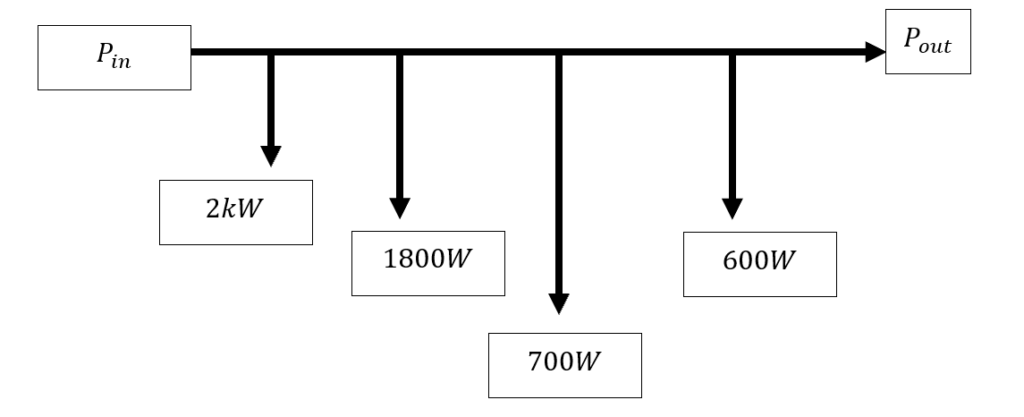
A 480 V, 60 Hz, 50 hp, three-phase induction motor draws 60 A at 0.85 power factor lagging. The losses in the motor are as follows:
- Stator copper losses: 2 kW
- Rotor copper losses: 700 W
- Friction and windage losses: 600 W
- Core losses: 1800 W
- Stray losses: negligible
Determine:
- The air-gap power (
)
- The power converted to mechanical form (
)
- The output power (
)
- The efficiency of the motor
Example Question Two
A three-phase induction motor has a power input of 40 kW. The machine has:
- Total stator loss: 1.5 kW
- Friction and windage loss: 800 W
- Rotor iron loss: negligible
When the motor operates at 4% slip, calculate:
(a) The gross mechanical power developed and the rotor copper loss.
(b) The useful output power and the efficiency of the motor.
Example Three
A three-phase, 50 Hz, six-pole induction motor operates with a slip of 4% while delivering an output power of 20 kW. The friction loss is 250 W. Calculate:
- The rotor speed (in revolutions per minute)
- The rotor copper loss (
loss)