
Power measurements of an induction motor are crucial for evaluating performance and efficiency, monitoring system health, managing energy consumption, and planning maintenance. There are two main ways to carry out power measurements:
The One-Watt Meter method uses a multi-meter to calculate real power and power factor in a single-phase system by measuring the phase voltage and line current. To get the power for all three phases it needs to multiplied by three. However, it’s worth noting that if there is an error, you are multiplying the error by three. This method is only suitable for balanced loads.
The Two-Watt Meter method delivers accurate results for both balanced and unbalanced systems. It involves measuring the current in two of the three phases and the voltages from those same two phases relative to the third line. This straightforward approach allows for precise measurement of total power, regardless of whether the system is unbalanced. Based on this simple test an accurate measurement of the total power regardless of it being unbalanced:
Note: If power factor is greater than 0.5 both P1 and P2 are positive, if power factor is 0.5 one of the readings is zero. Less than 0.5 one of the readings will be negative (usually P1)
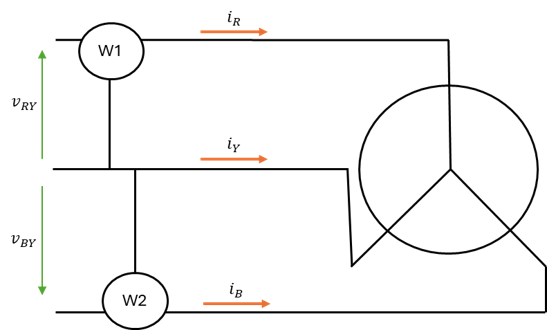
Note: The current above values will be the instantaneous value not sinusoidal and as we are talking about electrical machines, this is the load connection, so will be balanced. If you get the instantaneous value for voltage and current, this give you the power. But we are measuring the voltages between lines.
Power Fact don’t need to worry about power factor when using instantaneous power.
Two-Watt Proof – Star Connection
Instantaneous power in the load:
Work done by each phase:
For the R-phase:
For the Y-phase:
Total work:
Expand:
If there is no star‑point connection
The line currents satisfy:
So:
Final result:
If there is a neutral or earth connection, this method will not be effective. According to Kirchhoff’s law, the sum of currents would not equal zero; instead, it would equal the current flowing through the neutral or earth. Therefore, when a neutral or earth is present, this method is only applicable for balanced loads, as it does not account for any measurements related to the neutral or earthing line. An induction motor is generally always balanced though.
Two-Watt Proof – Delta Connection
Instantaneous load power
Work done
For phase 1:
For phase 2:
Total work:
Expanded:
But:
So:
Kirchhoff’s Voltage Law around the delta
From the loop:
Thus:
Therefore:
In a balanced load, the Two-Watt Meter Method can be employed to determine the power factor. It’s a common myth that an induction motor typically operates at a power factor of 0.80 to 0.85, but this is only true when it is running at full speed and maximum power. The power factor is generally lower when the motor is not operating at maximum power.
The power factor reflects the relationship between voltage and current. In a three-phase balanced system, all phases will exhibit the same power factor. Conversely, in an unbalanced system, there will be three distinct power factors.
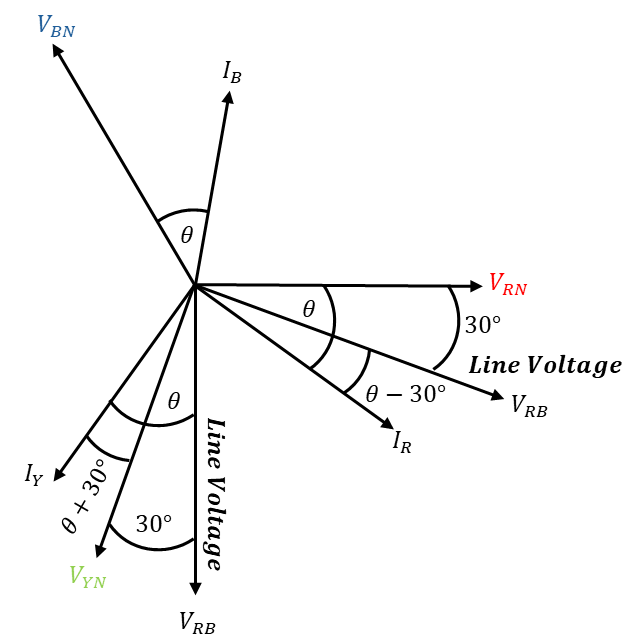
Readings from the watt meter can be represented on a phasor diagram. It is important to note that we are measuring the line voltage, and to calculate the power factor (cosine(theta)), we need the phase angle of both the phase current and phase voltage, or the line current and line voltage. In this example, we convert to phase values. When transitioning from line voltage to phase voltage, the angle shifts by 30 degrees. (Note, the shift is always towards the reference phase or in other words, the phase not connected to a watt-meter.) The difference between the phase voltage and the phase current indicates the q, which can be used to find the power factor. The angles can then be calculated in reverse; the angle between the phase current and the line voltage is theta minus 30 degrees, as illustrated below.

This process can then be applied to the other phases accordingly. It is common practice to have all angles indicated in the same direction, typically clockwise. However, since we are measuring the line voltage, we can also display the phase voltage. In this context, it is important to note that the angle is shifted 30 degrees towards the reference point to obtain the phase voltage, as illustrated below.
Sum of wattmeter readings
Using the identity:
We get:
Since:
Therefore:
Difference of wattmeter readings
Using the identity:
We get:
And since:
Then:
Note – The total power is given by:
which is the well‑known power equation for a three‑phase system.
Dividing equation (2) by equation (1) :
If power factor is less than 0.5, one of the readings will be negative and that will be P2 as Tangent it does not have negative values.
Example Question 1
The input power to a three‑phase motor was measured using the two‑wattmeter method, with the wattmeters indicating readings of 5.2 kW and –1.7 kW. Given that the line voltage was 415 V, calculate (a) the total active power, (b) the power factor, and (c) the line current.
Example Question 2
A three‑phase balanced load that dissipates 1200 W at a lagging power factor of 0.918 undergoes testing using the two‑wattmeter method, and the task is to predict the readings that will be shown on each instrument.