A transformer is an essential device used in electrical circuits to modify voltage and current levels. It serves a vital function within the energy network by facilitating the efficient transmission of electricity. Additionally, transformers help to regulate and maintain voltage levels within a range that is suitable for consumers, ensuring that the electricity supplied is both safe and effective for use.
A transformer is composed of two wire windings that are positioned around a magnetic iron core, and it operates based on the principles outlined in Faraday’s Law of electromagnetic induction. The winding that is connected to the power source is called the primary winding, while the winding that connects to the load is referred to as the secondary winding. The primary winding receives electrical energy from the power source, which generates a magnetic field around the iron core. This magnetic field is crucial as it facilitates the transfer of energy between the two windings. As the magnetic field fluctuates, it induces a voltage in the secondary winding, effectively converting the electrical energy from the primary winding into magnetic energy, this magnetic energy is then transformed back into electrical energy in the secondary winding, allowing it to supply power to the connected load. Transformers are fundamental components in electrical systems, enabling the efficient transmission and distribution of electricity across various distances. By adjusting voltage levels, they help to ensure that electrical energy can be delivered safely and effectively to homes and businesses, while also minimizing energy losses during transmission.
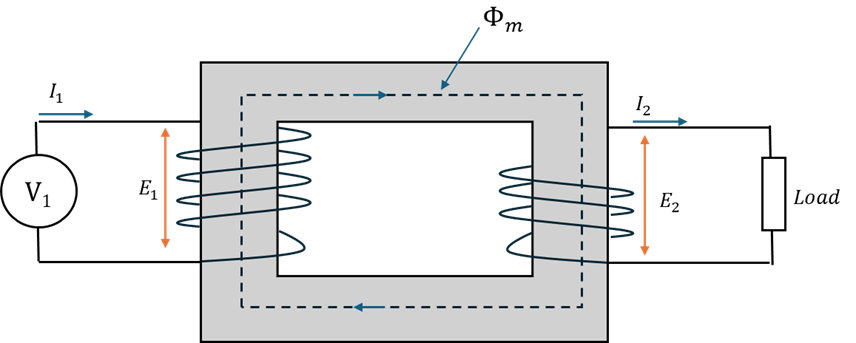
Transformers are not completely efficient, with typical efficiency ratings hovering around 98%. This means that there are inherent losses within the components of each transformer that prevent it from achieving 100% efficiency. These losses can arise from various factors, including resistance in the wire windings, core losses due to hysteresis and eddy currents, and flux leakage. Understanding the efficiency of transformers is crucial for accurately drawing their equivalent circuits. The equivalent circuit represents the transformer’s behaviour in a simplified manner, allowing engineers to analyse its performance under different operating conditions. By accounting for the inefficiencies, one can better predict how the transformer will respond to varying loads and voltages, ultimately leading to more effective design and operation within electrical systems. This knowledge is essential for optimizing transformer performance and ensuring reliable energy distribution.
The losses in a transformer include core losses and winding resistance. The core requires a certain amount of current to become magnetised, mainly due to hysteresis. Most of this magnetising current is reactive, though a small portion is resistive.
From the diagram above, you can see that most of the current is converted into magnetic flux that circulates around the core, while some is used internally to magnetise the core. In effect, the magnetising current splits into two paths, meaning the core losses are represented as being in parallel with the main power flow.
Additional losses also exist, such as magnetic flux leakage and winding resistance. Flux leakage occurs when some of the magnetic flux produced by the windings does not enter the core and instead “leaks” around it. This leakage behaves as a reactive component and appears in series with the main current path. Since the transformer has two windings, this effect is present on both the primary and secondary sides.
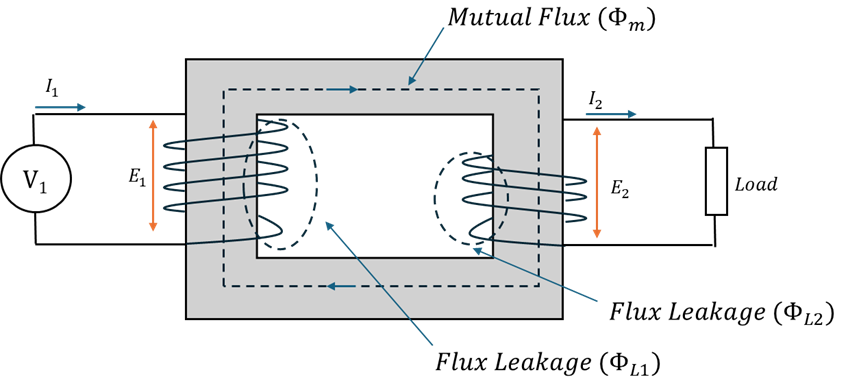
The reactances and winding resistances can be shown separately on a diagram while still representing the same overall electrical behaviour. This separation is often done simply to highlight the differences between them and to make the diagram easier to interpret.
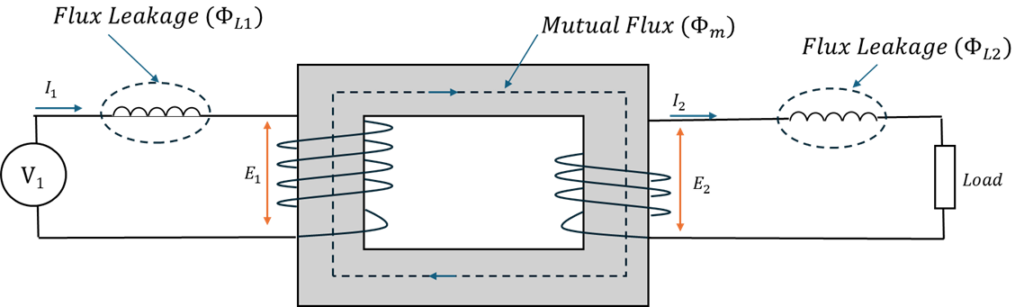
From the diagram below, we can see that two induced EMFs are present: one across the leakage reactance and another across the winding. As a result, the primary induced EMF is made up of the EMF associated with the leakage flux as well as the EMF produced by the mutual flux. The same principle applies on the secondary side.
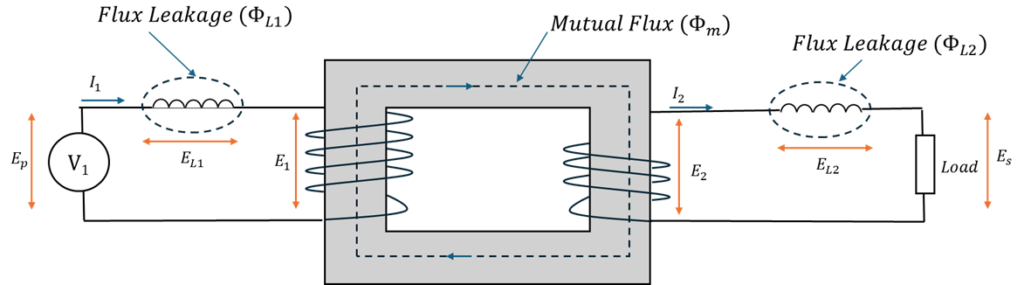
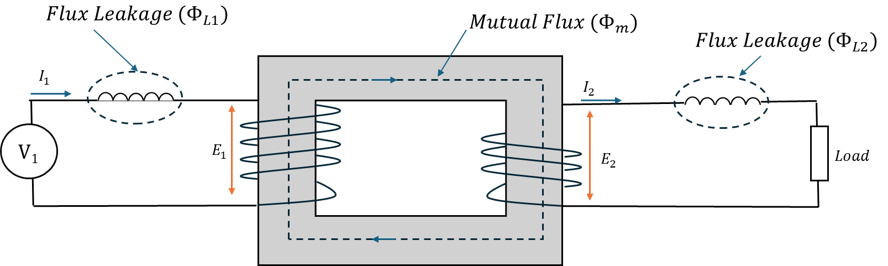
However, by examining the diagram and applying basic principles, we can see that a voltage drop must occur across the leakage reactance due to the presence of flux leakage. We can extend this idea further by also separating out the resistive component of the winding. Doing so gives us the following representation of the transformer:
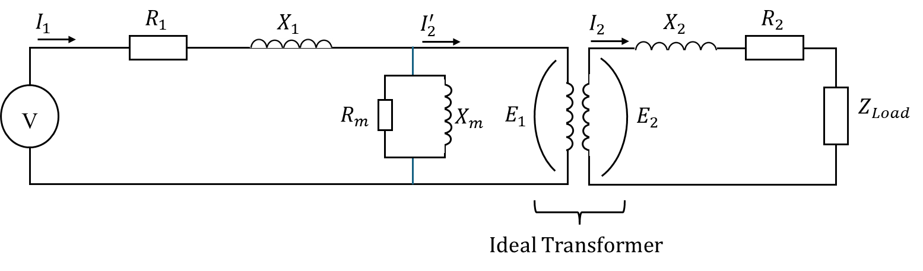
Taking all of the above into consideration, namely the leakage reactances, winding resistances, and the core losses, the complete equivalent circuit of the transformer can be represented as follows:
Recap
- R₁ and R₂ represent the resistances of the primary and secondary windings.
- X₁ and X₂ are the respective leakage reactances of the primary and secondary windings.
- Xₘ is the magnetising reactance, chosen such that it draws the reactive magnetising current Iₘ of the actual transformer.
- Rₘ models the core loss, taking the in‑phase component Iₚ of the primary current.
To proceed, everything must be referred to one side of the transformer, either the primary or the secondary. For simplicity, we will refer all quantities to the primary side.
To do this, we must apply the turns ratio before transferring impedances or voltages. For an ideal transformer, the following relationship holds true:
So,
We know impedance is:
Using the relations above:
Thus,
This applies individually to resistances and reactances:
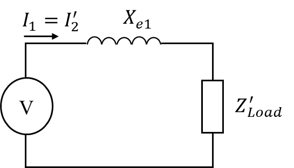
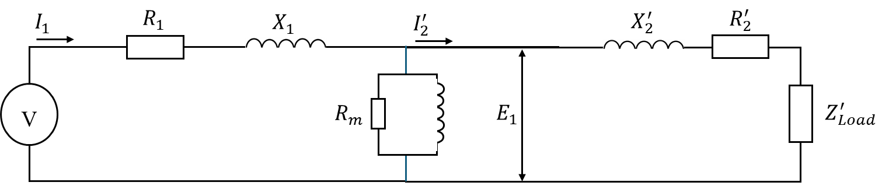
Once all the individual parts have been calculated when referred to the primary side. This is what the diagram looks like:
The exact equivalent circuit of the transformer is too exact for most practical engineering applications. Consequently, we can simplify it to make calculations easier.
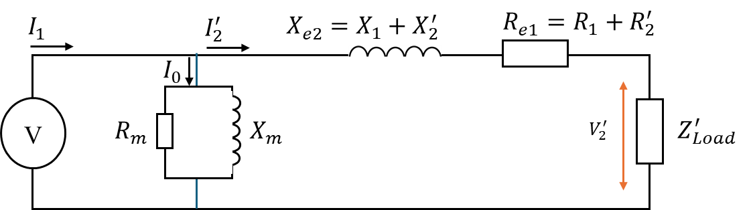
In many practical analyses, the core‑loss resistance and magnetising reactance are also ignored, as their impact is often considered minor. Removing the core‑loss branch does not introduce any additional voltage drop and therefore has no effect on voltage‑regulation calculations.
For transformers rated above approximately 500 kVA, where the excitation reactance Rm is typically more than five times the core‑loss resistance Xm, this simplified model provides sufficiently accurate results for calculations such as voltage regulation. Under these conditions, the following simplified equivalent circuit may be used: