
What Are Insulators?
In an electrical power grid, insulators are components that prevent unwanted flow of electricity while allowing conductors to be mechanically supported and safely positioned. Their role is both electrical and structural, and they are essential for safe, reliable grid operation.
Electrically, insulators separate live conductors from grounded structures such as towers, poles, and substations. High‑voltage equipment operates at potentials that would cause current to flow to earth if a conductive path existed. Insulators provide very high electrical resistance, ensuring electricity remains confined to the conductors and equipment it is intended to flow through, rather than leaking into supporting structures or the surrounding environment.
Mechanically, insulators support the physical weight and tension of overhead lines and substation busbars. Transmission conductors are heavy and subjected to mechanical forces such as wind, ice loading, and thermal expansion. Insulators transfer these forces safely to towers or gantries while maintaining electrical separation. Different designs, such as suspension insulators and strain insulators, are selected based on the mechanical loads present.
Environmentally, insulators are designed to withstand weather, pollution, and contamination. Outdoor grid equipment is exposed to rain, fog, salt, dust, and industrial pollution. Insulators maintain adequate surface leakage distance to prevent flashover, where current travels over the surface rather than through the air. In more aggressive environments, longer or specially profiled insulators are used.
From a safety perspective, insulators protect people, animals, and equipment. By maintaining electrical isolation, they reduce the risk of electric shock, fires, and damage to grid assets. A failed or contaminated insulator can lead to flashovers, faults, or outages, which is why insulator condition is a critical part of grid maintenance.
How are they constructed?
Electrical grid insulators are constructed to combine high electrical resistance, mechanical strength, and environmental durability. While designs vary by voltage level and application, their construction follows the same core principles.
At a high level, an insulator consists of an insulating body, metal end fittings, and a bonding interface that permanently joins the two.
The insulating body is the main part and is made from one of three materials.
Traditional insulators are made from porcelain, which is produced by firing refined clay and alumina at high temperatures to form a dense ceramic with excellent dielectric strength. Porcelain insulators are usually coated with a glass glaze to seal the surface and reduce moisture absorption.
Another common material is toughened glass, used mainly for disc insulators on transmission lines. Molten glass is moulded and rapidly cooled so the surface is in compression, giving high mechanical strength and predictable failure behaviour.
Modern designs increasingly use composite (polymer) materials, typically silicone rubber bonded to a fibreglass‑reinforced epoxy core. These materials provide excellent pollution performance and high strength with much lower weight. The core or load‑bearing structure depends on the insulator type.
In porcelain and glass insulators, the ceramic or glass body itself carries the mechanical load.
In composite insulators, the load is carried by a fibreglass rod, which provides high tensile strength, while the silicone rubber housing provides electrical insulation and environmental protection.
Metal end fittings are attached to the insulating body to allow installation on towers, crossarms, or equipment. These fittings are typically made from forged or cast steel or malleable iron and are galvanised to prevent corrosion. Common arrangements include pin fittings, cap‑and‑pin designs for suspension strings, and end clevises for long‑rod insulators.
The bonding process between the insulating body and the metal fittings is critical.
For porcelain and glass insulators, the fittings are attached using cement (usually Portland cement with additives), which mechanically locks the metal to the insulating body once cured.
For composite insulators, the metal fittings are typically crimped onto the fibreglass core and then sealed, rather than cemented, creating a strong mechanical joint that is resistant to vibration and ageing.
To improve electrical performance, the outer surface of the insulator is shaped with sheds or skirts. These increase the creepage distance, which helps prevent surface leakage currents and flashover, particularly in polluted or wet environments. In composite insulators, the silicone rubber surface also has hydrophobic properties, causing water to bead rather than form a continuous conductive film.
Finally, insulators undergo factory testing before installation. This typically includes mechanical tensile tests, power‑frequency withstand tests, impulse voltage tests, and environmental ageing tests. These confirm that the construction meets both electrical and mechanical design requirements for long‑term grid operation.
How are they constructed?
Electrical grid insulators are constructed to combine high electrical resistance, mechanical strength, and environmental durability. While designs vary by voltage level and application, their construction follows the same core principles.
At a high level, an insulator consists of an insulating body, metal end fittings, and a bonding interface that permanently joins the two.
The insulating body is the main part and is made from one of three materials.
Traditional insulators are made from porcelain, which is produced by firing refined clay and alumina at high temperatures to form a dense ceramic with excellent dielectric strength. Porcelain insulators are usually coated with a glass glaze to seal the surface and reduce moisture absorption.
Another common material is toughened glass, used mainly for disc insulators on transmission lines. Molten glass is moulded and rapidly cooled so the surface is in compression, giving high mechanical strength and predictable failure behaviour.
Modern designs increasingly use composite (polymer) materials, typically silicone rubber bonded to a fibreglass‑reinforced epoxy core. These materials provide excellent pollution performance and high strength with much lower weight.
The core or load‑bearing structure depends on the insulator type.
In porcelain and glass insulators, the ceramic or glass body itself carries the mechanical load.
In composite insulators, the load is carried by a fibreglass rod, which provides high tensile strength, while the silicone rubber housing provides electrical insulation and environmental protection.
Metal end fittings are attached to the insulating body to allow installation on towers, crossarms, or equipment. These fittings are typically made from forged or cast steel or malleable iron and are galvanised to prevent corrosion. Common arrangements include pin fittings, cap‑and‑pin designs for suspension strings, and end clevises for long‑rod insulators.
The bonding process between the insulating body and the metal fittings is critical.
For porcelain and glass insulators, the fittings are attached using cement (usually Portland cement with additives), which mechanically locks the metal to the insulating body once cured.
For composite insulators, the metal fittings are typically crimped onto the fibreglass core and then sealed, rather than cemented, creating a strong mechanical joint that is resistant to vibration and ageing.
To improve electrical performance, the outer surface of the insulator is shaped with sheds or skirts. These increase the creepage distance, which helps prevent surface leakage currents and flashover, particularly in polluted or wet environments. In composite insulators, the silicone rubber surface also has hydrophobic properties, causing water to bead rather than form a continuous conductive film.
Finally, insulators undergo factory testing before installation. This typically includes mechanical tensile tests, power‑frequency withstand tests, impulse voltage tests, and environmental ageing tests. These confirm that the construction meets both electrical and mechanical design requirements for long‑term grid operation.
How are they constructed?
Electrical grid insulators are constructed to combine high electrical resistance, mechanical strength, and environmental durability. While designs vary by voltage level and application, their construction follows the same core principles.
At a high level, an insulator consists of an insulating body, metal end fittings, and a bonding interface that permanently joins the two.
The insulating body is the main part and is made from one of three materials.
Traditional insulators are made from porcelain, which is produced by firing refined clay and alumina at high temperatures to form a dense ceramic with excellent dielectric strength. Porcelain insulators are usually coated with a glass glaze to seal the surface and reduce moisture absorption.
Another common material is toughened glass, used mainly for disc insulators on transmission lines. Molten glass is moulded and rapidly cooled so the surface is in compression, giving high mechanical strength and predictable failure behaviour.
Modern designs increasingly use composite (polymer) materials, typically silicone rubber bonded to a fibreglass‑reinforced epoxy core. These materials provide excellent pollution performance and high strength with much lower weight.
The core or load‑bearing structure depends on the insulator type.
In porcelain and glass insulators, the ceramic or glass body itself carries the mechanical load.
In composite insulators, the load is carried by a fibreglass rod, which provides high tensile strength, while the silicone rubber housing provides electrical insulation and environmental protection.
Metal end fittings are attached to the insulating body to allow installation on towers, crossarms, or equipment. These fittings are typically made from forged or cast steel or malleable iron and are galvanised to prevent corrosion. Common arrangements include pin fittings, cap‑and‑pin designs for suspension strings, and end clevises for long‑rod insulators.
The bonding process between the insulating body and the metal fittings is critical.
For porcelain and glass insulators, the fittings are attached using cement (usually Portland cement with additives), which mechanically locks the metal to the insulating body once cured.
For composite insulators, the metal fittings are typically crimped onto the fibreglass core and then sealed, rather than cemented, creating a strong mechanical joint that is resistant to vibration and ageing.
To improve electrical performance, the outer surface of the insulator is shaped with sheds or skirts. These increase the creepage distance, which helps prevent surface leakage currents and flashover, particularly in polluted or wet environments. In composite insulators, the silicone rubber surface also has hydrophobic properties, causing water to bead rather than form a continuous conductive film.
Finally, insulators undergo factory testing before installation. This typically includes mechanical tensile tests, power‑frequency withstand tests, impulse voltage tests, and environmental ageing tests. These confirm that the construction meets both electrical and mechanical design requirements for long‑term grid operation.
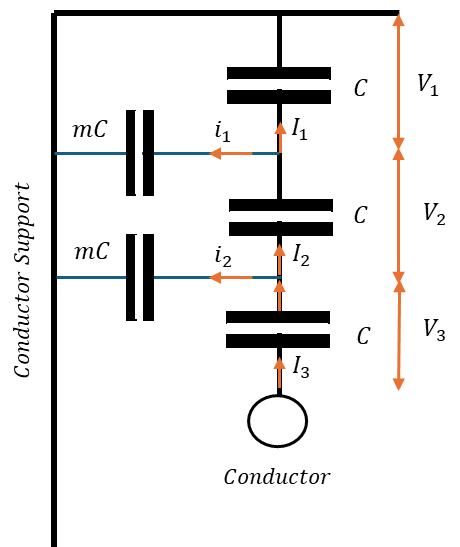
But we want in terms of voltage, so using the following equations to get 
 :
:
Therefore, substituting we get:
We can use the same theory for the remaining insulators. However, it’s important to note that capacitance effect is cumulative in relation to the ground/conductor support. Therefore, for insulator 3 the following is true:
But we know what V2 is, so substituting this into the above equation:
Example:
In a string of 3 units the capacitance between each link pin to earth is 18% of the capacitance of one unit. Calculate the voltage across each unit and the string efficiency when the voltage across the string is 33kV.
We know the potential difference between the conductor and the earth is 33kV, so therefore the potential difference across all insulators must add to 33kV.
Now we know  we can use this to work out the potential difference across each insulator:
What we see here is that the insulator closest to the conductor always has the greatest potential difference across it. Why is this the case?
The underlying cause of the non‑uniform voltage distribution along an insulator string is the cumulative capacitance that exists between each insulator unit and the supporting structure, such as the tower or cross‑arm. Each insulator disc does not operate in isolation; instead, the capacitance between the metal fittings of the insulators and earth increases progressively for units closer to the support. As a result, the capacitive coupling to ground effectively accumulates along the string, influencing how the applied voltage is shared between individual insulators.
In an ideal situation, the potential difference would be evenly distributed across all insulator units so that each disc experiences the same electrical stress. This would maximise utilisation of the insulation material and improve overall reliability. In practice, however, this is not achievable due to the presence of mutual capacitance between adjacent units and capacitance to ground, which causes part of the charging current to bypass individual insulators. While a perfectly uniform distribution is impossible, careful design can produce insulator strings that are more efficient than others in terms of how evenly the voltage is shared.
The effectiveness of an insulator string in distributing voltage is quantified using the concept of string efficiency, which compares the average voltage per insulator to the maximum voltage appearing across any single unit. A higher string efficiency indicates a more uniform voltage distribution and reduced electrical stress on the most highly loaded insulator, typically the one nearest the conductor.
Where N= number of insulators in the string
It is essential that individual insulators are mechanically and electrically robust enough to withstand the maximum potential difference they may experience in service. If an insulator is subjected to a voltage stress beyond its design limit, internal breakdown or surface flashover can occur, potentially leading to cracking, shattering, or permanent loss of insulating capability. Such failures compromise system safety and can result in outages or damage to adjacent equipment.
For these reasons, voltage distribution along an insulator string is inherently non‑uniform, particularly under alternating current conditions and at high voltage levels. To mitigate this effect and protect the most heavily stressed units, grading techniques such as grading rings are commonly employed. These devices modify the electric field distribution around the string, reducing the voltage concentration at the conductor end and improving the overall string efficiency, thereby enhancing both reliability and service life in high‑voltage applications.